Introduction
Pharma and biotech medical affairs teams have a KOL problem: the experts they engage most often aren't always the experts who actually move a field. Publication counts and conference invitations are lagging indicators — they reward visibility, not influence. As competition for scientific advocacy tightens and AI-driven search increasingly surfaces "who's saying what" in a therapeutic area, life sciences organizations are shifting from subjective KOL lists to Key Opinion Leader Expert Network, a data-driven method for mapping who actually shapes research direction, prescribing behavior, and clinical consensus.
This shift matters now for a specific reason: generative search engines and AI Overviews increasingly cite the researchers and institutions with the strongest network signal, not just the highest h-index. Medical affairs, market access, and commercial teams that can quantify influence — rather than guess at it — are better positioned for advisory boards, publication planning, and congress strategy heading into 2026.
What Is a Key Opinion Leader, and Why Traditional Identification Falls Short
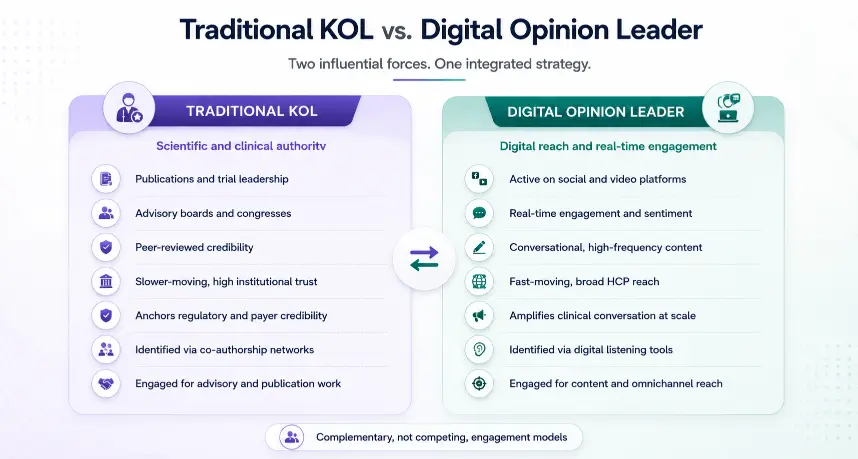
A Key Opinion Leader is a researcher or clinician whose insights carry outsized weight within a scientific community — an "agent of change" who accelerates how new evidence spreads and is adopted. Traditionally, life sciences companies identify KOLs through publication volume, speaking engagements, or internal nominations from sales and medical liaisons.
This approach is fast but structurally biased: it favors prolific self-promoters over the researchers who actually bridge disconnected pockets of a field. Network analysis addresses this gap by treating influence as a relational property, not an individual attribute. Instead of asking "how many papers has this person published," SNA asks "how positioned is this person within the collaboration structure of the field."
How Social Network Analysis Works in a Pharma Context
SNA maps researchers as nodes and their relationships — co-authorship, co-investigator status on trials, shared grants, conference co-presentations — as edges. Several metrics matter for KOL identification:
- Degree centrality flags prolific collaborators with many direct connections.
- Betweenness centrality identifies "bridge" researchers who connect otherwise separate research clusters — often the most strategically valuable KOLs for cross-disciplinary programs.
- Eigenvector/PageRank centrality captures influence through well-connected neighbors, though research shows over-concentration among already-elite collaborators can actually correlate with lower relative citation impact.
- Community detection algorithms reveal subfields, institutional clusters, or emerging therapeutic-area factions that a company's current KOL roster may be missing entirely.
Layered on top of publication and co-authorship data, organizations increasingly build multiplex networks that combine bibliometric ties with clinical trial investigator records, grant co-PI relationships, and social/altmetric signals — giving a fuller picture of influence across channels rather than relying on any single data source.
Ready to Build a More Defensible KOL Map?
Use data-driven network intelligence to identify influential experts, uncover emerging voices, and strengthen scientific engagement decisions.
Get in Touch →Why Life Sciences Companies Are Adopting This Now
Three forces are converging to push social network analysis from an academic technique into standard medical affairs practice: fragmented influence signals, the growing importance of AI search visibility, and pressure to justify advisory and engagement spend with defensible evidence.
How Companies Are Implementing KOL Network Mapping
Implementation typically follows a structured pipeline: define the therapeutic area and objective, pull data from bibliographic databases such as PubMed, Scopus, and Web of Science and funding sources such as NIH RePORTER and CORDIS, resolve author identity conflicts using ORCID and disambiguation tools, then construct and analyze the network.
Tooling choices depend on scale and team skill set. Gephi and VOSviewer are common for exploratory visualization and bibliometric mapping respectively; Cytoscape suits teams already working in biological or pathway contexts; NetworkX supports custom, reproducible analysis pipelines for data science teams; and Neo4j or commercial platforms like SciVal handle enterprise-scale networks with millions of relationships.
Mid-size medical affairs teams often start with VOSviewer or Gephi before graduating to programmatic pipelines as their KOL universe grows. Once ranked, candidate KOLs are validated against qualitative expert review — network metrics alone can misidentify influence, since a highly connected researcher isn't automatically a persuasive communicator or a good advisory-board fit.
Why Life Sciences Companies Are Adopting Network Analysis Now
Three forces are converging to make SNA increasingly important for 2026 KOL strategy:
Fragmented influence signals.
Influence now lives across PubMed, clinical trial registries, grant databases, LinkedIn, and conference platforms simultaneously — no single source tells the full story anymore.
AI search visibility.
As AI Overviews, Perplexity, and other answer engines synthesize who the leading experts are, rigorous KOL mapping becomes part of broader digital and scientific visibility strategy.
ROI pressure on advisory spend.
Advisory boards, speaker programs, and publication support are expensive. Companies want defensible, quantifiable justification for who gets invited — for both budget efficiency and compliance transparency.
Industry Insight: Where This Is Heading
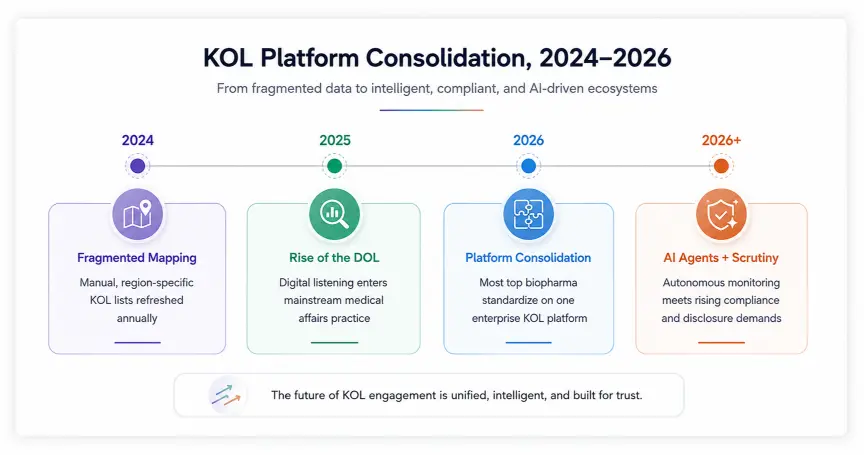
KOL strategy is moving toward more dynamic, multi-source models. Organizations are increasingly looking beyond static publication counts to understand how influence changes over time, how scientific conversations move across channels, and how documented network signals can support more transparent expert-selection decisions.
Expect three developments to shape KOL strategy through 2026 and beyond:
Dynamic and temporal networks
Teams will use time-based network models to identify rising digital KOL intelligence before competitors do, rather than recognizing influence only after an expert is already established.
Altmetric and social listening integration
Traditional co-authorship graphs will increasingly incorporate social and altmetric signals as scientific conversation extends beyond journals and conferences.
Greater compliance scrutiny
Documented, metrics-based KOL identification will become a risk-mitigation tool as organizations face increased scrutiny around paid relationships and transparency.
Frequently Asked Questions
Conclusion
Network-based KOL mapping in pharma gives life sciences organizations something publication counts and internal nominations can't: a defensible, data-driven map of who actually shapes a field's direction. As AI search tools increasingly surface expertise algorithmically and compliance scrutiny on KOL engagement grows, the companies investing in rigorous SNA methodology now — rather than relying on legacy nomination processes — will have a durable advantage in advisory strategy, publication planning, and scientific visibility.